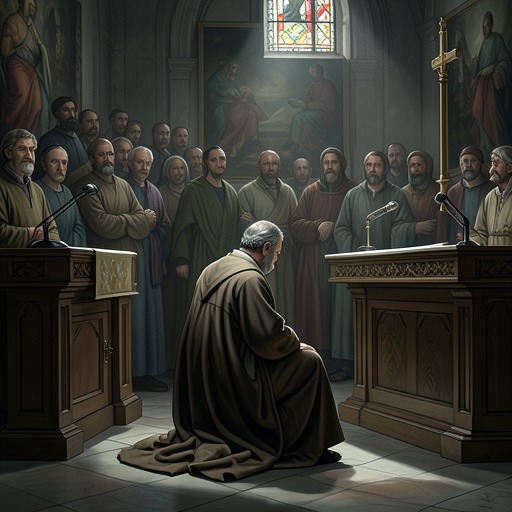
Turelure
The Parallax ViewTurelure is the political climber and hated husband at the center of Sygne de Coufontaine’s sacrifice in Paul Claudel’s play The Hostage. He benefits from the Revolution and from Sygne’s marriage to him, but her final refusal to give his survival a consoling meaning makes him the recipient of a sacrifice he cannot claim as an act of love or marital duty.
Identity and Background
Turelure is the son of Sygne’s servant and wet nurse. He uses the Revolution to advance his career, becoming a Jacobin local potentate. His rise is inseparable from Sygne’s family’s ruin: he ordered the execution of her parents in front of their children. The book presents him as corrupted and repugnant to Sygne, and as an enemy bound to her through a marriage she accepts for reasons that have nothing to do with affection.
Marriage and Sygne’s Sacrifice
When the Pope is hiding in Sygne’s house, she agrees to marry Turelure in order to save him. The decision costs her the life she had pledged to Georges, her family name, and her estate. Turelure thus becomes the beneficiary of a profound renunciation, but not its motivating cause: Sygne’s choice is made to protect the Pope, a symbol of the old order. Her marriage joins her to the man who helped destroy her family and requires her to relinquish the attachments and inheritance that defined her former life.
The Gunshot and the Final Exchange
Later, Georges aims a pistol at Turelure. Sygne places herself between them and intercepts the bullet, saving her husband’s life and suffering a fatal wound. The account identifies this act—not merely her final refusal—as the central enigma: the gesture cannot be reduced to an obvious motive such as marital affection, duty, or an instinctive impulse to save a threatened life.
At Sygne’s bedside, Turelure desperately asks her to give some sign that would explain what she has done. He is prepared to accept even an explanation that does not involve love, including one that would present her action as an effort to protect the family name from disgrace. Sygne gives no spoken answer. A compulsive tic repeatedly distorts her face, making her body communicate refusal where speech does not.
The Meaning of Her Refusal
The book reads Sygne’s bodily no not as the disclosure of a hidden private motive, but as a refusal to place her act within a familiar economy of sacrifice. Turelure cannot turn her intervention into proof of love, obedience, or some other recognizable justification. Her gesture is described as an act performed for its own sake, without a compensating return or a calculation that would make the loss meaningful.
That refusal also makes Turelure’s place in the relationship sharply unequal: he lives because Sygne intervenes, yet he cannot secure her affirmation of him. Her sacrifice binds her to an order represented by her enemy, while her final negation challenges the meaning that order would assign to her action. Turelure is therefore more than the despised husband who survives the shot; he is the person left asking for a reconciliation that Sygne’s last gesture does not grant.